
Jesus According to Jesus Jesus According to Jesus
Menu
Button 1 Jesus365 Button 2 Oyo Yesu alobaki Button 3 Bato oyo bakutanaki na Yesu Button 4 Landa Yesu Button 5 His Final Days Button 6 Sango Malamu
Etali bisoLisungiSololá na bisoKɔ́tá
Lingála🌐 +29
Poná lokota
  • English
  • Français
  • Español
  • Português
  • Kiswahili
  • العربية
  • Hausa
  • Wolof
  • తెలుగు
  • 中文
  • हिन्दी
  • Tiếng Việt
  • አማርኛ
  • Yorùbá
  • فارسی
  • ਪੰਜਾਬੀ
  • Soomaali
  • Filipino
  • Italiano
  • Deutsch
  • Türkçe
  • Bamanankan
  • Lingála
  • Malagasy
  • Română
  • Nederlands
  • Русский
  • Ελληνικά
  • தமிழ்
  • Bahasa Indonesia
  • https://www.facebook.com/
  • https://twitter.com/
  • https://t.me/
  • https://www.instagram.com/
  • https://youtube.com/
Skip to content
Sololá na biso
Skip to content
-
Jesus According to Jesus Jesus According to Jesus Yesu ndenge Yesu moko alobi

Mituna na yo. Bomoyi na yo. Maloba ya Yesu.Tala ntina, bolimbisi, mpe elikya ya bomoyi ya seko.

  • Ebandeli
  • Etali biso
  • Biteni
  • Maloba
    • What Jesus says on certain topics
    • Who Jesus Says He Is
    • What Jesus Says He Came to Do
  • His Final Days
    • Palm Sunday
    • Monday
    • Tuesday
    • Wednesday
    • Thursday
    • Friday
    • Saturday
    • Sunday
  • Sango Malamu
  • Sololá na biso
  • Kɔ́tá
  • Lisungi
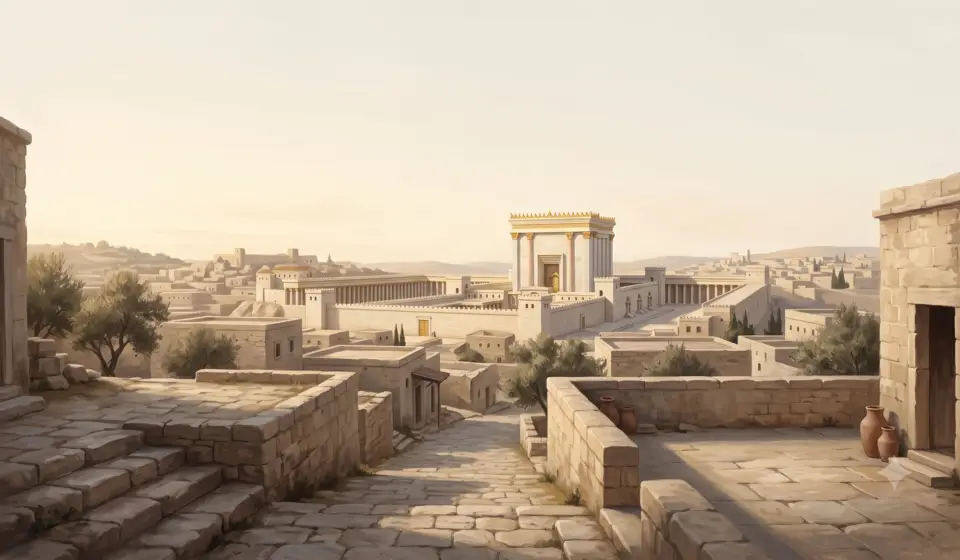
Ancient Jerusalem temple complex in warm morning light, viewed from quiet stone steps with an upward path leading toward the temple.

The First Recorded Words of Jesus: “My Father’s House”.

Share with others
WhatsAppXFacebookEmail

This is Jesus According to Jesus. This reflection belongs to our Chronological Sayings of Jesus collection. Its focus is this: The sayings of Jesus arranged in narrative order, following the flow of His public ministry from His earliest recorded words to His final teachings, crucifixion, resurrection, and commission. Listen carefully and think about what Jesus says. Let’s begin.

Primary Text: Luke 2:41–52

Main Saying: “Did you not know that I must be in my Father’s house?” — Luke 2:49

Before Jesus ever preaches a sermon, heals the sick, casts out demons, forgives sins, or predicts His death and resurrection, Luke gives us one scene from His childhood.

It is easy to skip over it.

But if we are asking, “Who is Jesus according to Jesus?” then this scene matters. These are the first recorded words of Jesus in the Gospels.

And they are not casual words.

Jesus in the Temple at Age Twelve.

Luke tells us that Jesus’ family went to Jerusalem every year for the Feast of Passover. When Jesus was twelve years old, they went up as usual.

After the feast ended, Mary and Joseph began the journey home. They assumed Jesus was somewhere in the traveling group, likely among relatives and acquaintances.

But He was not.

After a day of travel, they began searching for Him. When they could not find Him, they returned to Jerusalem.

For three days, they searched.

That detail matters. This was not a brief misunderstanding. Mary and Joseph were distressed. Any parent can understand the panic.

Finally, they found Him in the temple.

Jesus was sitting among the teachers, listening to them and asking questions. Luke says everyone who heard Him was amazed at His understanding and His answers.

Notice the balance. Jesus is not pictured as a noisy child showing off. He is listening. He is asking. He is answering. He is engaging the teachers of Israel in the place where Scripture, worship, sacrifice, and national hope all came together.

This is Jesus in the temple at age 12.

And then Mary speaks.

“Son, why have you treated us so? Behold, your father and I have been searching for you in great distress.”

Her words are understandable. She speaks as a mother. She names the pain of the search.

Jesus answers:

“Why were you looking for me? Did you not know that I must be in my Father’s house?”

“Did You Not Know?”

This is where the scene becomes more than a childhood memory.

Jesus does not say, “I got distracted.”

He does not say, “I lost track of time.”

He does not say, “I wanted to talk to the teachers.”

He says, “Did you not know?”

That answer assumes that His presence in the temple should make sense once His identity is understood.

To a skeptical reader, this is worth slowing down.

Luke is not presenting Jesus as a child who merely enjoys religion. He is presenting Jesus as a child who already understands Himself in relation to God in a unique way.

Mary says, “your father and I.”

Jesus says, “my Father.”

That contrast is gentle, but serious.

Jesus returns to Nazareth with Mary and Joseph and submits to them. So this is not teenage disrespect. Luke explicitly removes that misunderstanding.

But Jesus is making something clear: His deepest identity is not finally explained by His earthly household.

He belongs to the Father.

“I Must Be in My Father’s House”.

The word “must” is important.

Jesus does not describe His presence in the temple as a preference. He describes it as necessity.

“I must be in my Father’s house.”

This is one of the earliest signs that Jesus understands His life as directed by divine purpose.

Later in the Gospels, Jesus will use this same kind of necessity language again.

He must preach the kingdom.

He must go to Jerusalem.

He must suffer.

He must be rejected.

He must be killed.

He must rise.

But here, the first “must” is connected to the Father.

That means the story of Jesus does not begin with public popularity, miracles, or confrontation. It begins with sonship.

Before Jesus stands before crowds, He stands in relation to the Father.

Before Jesus announces the kingdom, He knows the Father’s house.

Before Jesus is publicly declared the beloved Son at His baptism, He already speaks as the Son who knows where He belongs.

What This Reveals About Jesus.

This passage does not tell us everything about Jesus.

It does not yet explain the cross. It does not yet reveal the resurrection. It does not yet show Him forgiving sins, commanding storms, or raising the dead.

But it does place the first stone in the road.

Jesus’ first recorded words reveal a child who is already conscious of God as His Father in a way that distinguishes Him even from His earthly family.

That is historically and theologically significant inside Luke’s Gospel.

Mary and Joseph do not fully understand Him. Luke says, “They did not understand the saying that he spoke to them.”

That detail is honest.

Even those closest to Jesus had to wrestle with who He was. They did not begin with a fully developed explanation of everything. They had to watch, remember, and slowly understand.

Luke says Mary treasured these things in her heart.

That is a good posture for the reader too.

Do not rush past the scene. Do not force a label too quickly. But do not soften the words either.

Jesus says He must be in His Father’s house.

Why These First Words Matter.

For a religious skeptic, this scene raises a question:

Was Jesus merely another teacher who later became exaggerated by His followers?

For a non-religious skeptic, the question may be even simpler:

When did Jesus begin to understand Himself as someone uniquely related to God?

Luke’s answer begins here.

At twelve years old, Jesus is not yet making public claims before the nation. But He is already speaking with a sense of divine sonship and mission.

So the first recorded words of Jesus are not a moral slogan. They are not advice. They are not a general statement about kindness or spirituality.

They are identity words.

“My Father’s house.”

The child in the temple will later become the man who says He was sent by the Father, speaks the Father’s words, does the Father’s will, and fulfills the Father’s mission.

The first words already point toward the central question:

Who is this Son who knows He belongs uniquely to the Father?

Stay Rooted in the Words of Jesus

No spam. Unsubscribe anytime. We respect your inbox.

Thank you for subscribing. Please check your inbox or spam folder and click the confirmation link to complete your subscription.

Part 1 · Chronological Sayings of Jesus

You are reading Movement 1 of 12: The First Recorded Words of Jesus: “My Father’s House”

This article is part of a chronological journey through Jesus’ own words. Start anywhere, but follow the whole movement to see what Jesus progressively reveals about Himself.

← Previous: This is the first movementNext: Movement 2 →
  1. Movement 1 of 12 · Current The First Recorded Words of Jesus: “My Father’s House” Luke 2:41–52
  2. Movement 2 of 12 · Next movement The Beloved Son in the Wilderness Matthew 3:13–4:11; Mark 1:9–13; Luke 3:21–4:13
  3. Movement 3 of 12 · Coming in this journey The Kingdom Is at Hand Matthew 4:12–25; Mark 1:14–39; Luke 4:14–44
  4. Movement 4 of 12 · Coming in this journey Who Then Is This? Matthew 8–9; Mark 1:40–5:43; Luke 5:12–8:56
  5. Movement 5 of 12 · Coming in this journey You Have Heard, But I Say Matthew 5–7; Luke 6:20–49
  6. Movement 6 of 12 · Coming in this journey Who Do You Say That I Am? Matthew 16:13–17:13; Mark 8:27–9:13; Luke 9:18–36
  7. Movement 7 of 12 · Coming in this journey Setting His Face Toward Jerusalem Luke 9:51–62; Luke 10–19; Matthew 19–20; Mark 10
  8. Movement 8 of 12 · Coming in this journey The King Comes to His Temple Matthew 21–22; Mark 11–12; Luke 19–20
  9. Movement 9 of 12 · Coming in this journey The Son of Man Will Come Matthew 24–25; Mark 13; Luke 21
  10. Movement 10 of 12 · Coming in this journey This Is My Blood of the Covenant Matthew 26:17–35; Mark 14:12–31; Luke 22:7–38; John 13–17
  11. Movement 11 of 12 · Coming in this journey The Condemned King Matthew 26:57–27:56; Mark 14:53–15:41; Luke 22:54–23:49; John 18–19
  12. Movement 12 of 12 · Coming in this journey All Authority Has Been Given to Me Matthew 28; Mark 16:1–8; Luke 24; John 20–21; Acts 1:1–11
Share with others
WhatsAppXFacebookEmail

Tags:

first recorded words of JesusJesus according to JesusJesus as a childJesus in the temple at age 12Luke 2 commentary
Mokomi

Waroal Peterson

Waroal Peterson is a staff writer for JesusAccordingToJesus.com, where he writes as a Christocentric apologist with a focused interest in the Gospel narratives and the progressive revelation of Jesus’ identity and mission. His work traces how Jesus reveals Himself through His own words, actions, conflicts, claims, compassion, suffering, death, and resurrection. Rather than beginning with religious labels or inherited assumptions, Waroal presses readers back into the text of the Gospels, asking what Jesus Himself says, shows, demands, promises, and fulfills. He is especially concerned with the unfolding logic of Jesus’ mission: the Son sent by the Father, the arrival of the kingdom, the call to repentance and faith, the authority to forgive sins, the necessity of the cross, and the vindication of the resurrection. His writing seeks to help readers see that the Gospel is not merely an idea to admire, but the announcement of who Jesus is and what He came to accomplish. Waroal writes for seekers, skeptics, new believers, and serious students of Scripture who want to encounter Jesus according to Jesus.


Follow Me
Other Reflexions
Oyo eleki

This Is My Blood of the Covenant.

Ancient Jerusalem temple complex in warm morning light, viewed from quiet stone steps with an upward path leading toward the temple.
Oyo elandi

Les premières paroles rapportées de Jésus : « La maison de mon Père ».

4 Comments
  1. The Beloved Son in the Wilderness – Jesus According To Jesus says:
    June 30, 2026 at 3:32 PM

    […] ← Previous: Movement 1Next: Movement 3 → […]

    Reply
  2. The Kingdom Is at Hand – Jesus According To Jesus says:
    June 30, 2026 at 6:24 PM

    […] Movement 1 of 12 · Already covered The First Recorded Words of Jesus: “My Father’s House” Lu… […]

    Reply
  3. Who Do You Say That I Am? – Jesus According To Jesus says:
    June 30, 2026 at 6:25 PM

    […] Movement 1 of 12 · Already covered The First Recorded Words of Jesus: “My Father’s House” Lu… […]

    Reply
  4. The King Comes to His Temple — Jesus Enters Jerusalem and Confronts Empty Religion – Jesus According To Jesus says:
    September 25, 2026 at 12:54 PM

    […] Movement 1 of 12 · Already covered The First Recorded Words of Jesus: “My Father’s House” Lu… […]

    Reply

Leave a Reply Cancel reply

Your email address will not be published. Required fields are marked *

You May Have Missed

Chronological Sayings of Jesus Gospel Context Reader Guides Maloba ya Yesu What Jesus Says He Came to Do

So Who Is Jesus, According to Jesus?

Waroal Peterson
By Waroal Peterson
August 10, 2026
Chronological Sayings of Jesus Gospel Context Maloba ya Yesu What Jesus Says He Came to Do Who Jesus Says He Is

All Authority Has Been Given to Me.

Waroal Peterson
By Waroal Peterson
July 28, 2026
Chronological Sayings of Jesus Gospel Context Maloba ya Yesu Who Jesus Says He Is

The King Comes to His Temple.

Waroal Peterson
By Waroal Peterson
July 28, 2026
Chronological Sayings of Jesus Gospel Context Maloba ya Yesu Who Jesus Says He Is

The Son of Man Will Come.

Waroal Peterson
By Waroal Peterson
July 22, 2026
Rocky landscape near Caesarea Philippi with rugged stone formations, distant hills, and a narrow path suggesting decision.
Chronological Sayings of Jesus Gospel Context Maloba ya Yesu

Who Do You Say That I Am?

Waroal Peterson
By Waroal Peterson
July 19, 2026
Galilean hillside overlooking the Sea of Galilee, with layered stone terraces and natural paths converging in morning light.
Chronological Sayings of Jesus Gospel Context Maloba ya Yesu

You Have Heard, But I Say.

Waroal Peterson
By Waroal Peterson
July 16, 2026
The Sea of Galilee under unsettled skies, with moving water in the foreground and calmer light breaking in the distance.
Chronological Sayings of Jesus Gospel Context Maloba ya Yesu

Who Then Is This?

Waroal Peterson
By Waroal Peterson
July 13, 2026
Ancient Galilee landscape in warm morning light with the Sea of Galilee, gentle hills, and a path leading toward the water.
Chronological Sayings of Jesus Gospel Context Maloba ya Yesu

The Kingdom Is at Hand.

Waroal Peterson
By Waroal Peterson
July 10, 2026
Lonely Judean wilderness at dawn with rocky hills, sparse desert brush, and a narrow path leading toward a bright horizon.
Chronological Sayings of Jesus Gospel Context Maloba ya Yesu

The Beloved Son in the Wilderness.

Waroal Peterson
By Waroal Peterson
July 7, 2026
Jesus According To Jesus

Yesu ndenge Yesu moko alobi

Jesus’ words plainly presented. No labels, no noise, no system first. Just His voice from the Gospels on sin, forgiveness, eternal life, judgment, and who He says He is.

  • Etali biso
  • Statements
  • Sololá na biso
  • Privacy Policy
  • Mibeko

Explore Jesus’ Words

  • Who Jesus Says He Is
  • What Jesus Says He Came to Do
  • Maloba ya Yesu
  • Topical Sayings of Jesus
  • Chronological Sayings of Jesus
  • Scripture Index

Start Here

  • Who Is Jesus According to Jesus?
  • What Must I Do to Be Saved?
  • Jesus on Sin and Repentance
  • Jesus on Forgiveness
  • Jesus on Eternal Life
  • Jesus on Judgment

Connect

Subscribe and follow for plain reflections on the words of Jesus from the Gospels.

Stay Rooted in the Words of Jesus

No spam. Unsubscribe anytime. We respect your inbox.

Thank you for subscribing. Please check your inbox or spam folder and click the confirmation link to complete your subscription.

XFacebookInstagramYouTubeTelegramWhatsApp
Sololá na biso
© 2026 • Yesu ndenge Yesu moko alobi • Mibeko nyonso mibatélami. Nkembo nyonso epesama na Nzambe.
Adrɛsi: 12020 Sunrise Valley Drive • Ste 100 • Reston, VA • 20105 • USA
Banda mobembo Tuna motuna Ebandeli Sɛngá lisungi Kota na lingomba
Nzela mosusu ya bomoyi

Motif ya bwanya

Ndenge bomoto ekoki kokosa biso moko

Makomi oyo ebombamaki ebatelami ndenge ezali; ebimeli na yango endimami naino awa te. Talá eteni ya Biblia oyo emonisami awa na nse.

Nini ekobongwana soki totalelaka moto nyonso na mawa oyo biso moko tolingaka bápesa biso na se?

Matthew 7:12

Tángá eteni ya Biblia mpe ebimeli na yango
Matayo 7:12 · OLCV
Nyonso oyo bolingaka ete bato mosusu basalela bino, bino mpe bosalaka yango mpo na bango ; pamba te yango nde mateya nyonso ya Mobeko mpe ya basakoli.

Biblica® Salela na bonsomi Mokanda na Bomoi™ Makomi na se ya bokonzi © 2002, 2020 Biblica, Inc. Biblica® Open Lingala Contemporary Bible™ Copyright © 2002, 2020 by Biblica, Inc.

OLCV · API.Bible

Kokangama na komona ete ozali sembo ekosila miso; koloba solo ekobikisa biso. Yesu abukaka komipesa sembo ya lokuta na biso te mpo na kotindola biso, kasi mpo na kopesa biso miso polele.

Mona ndenge maloba oyo ekangami→
Mot clé 294 na kati ya 365JesusAccordingToJesus.com